
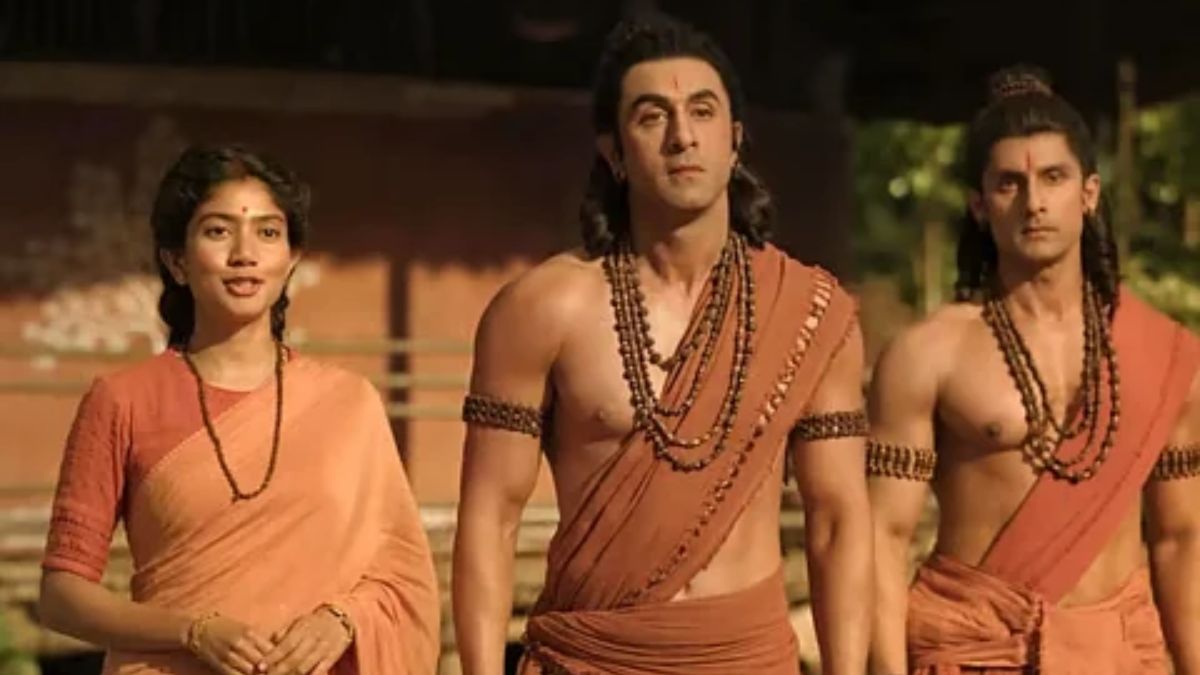

Sai Pallavi’s portrayal of Sita in Nitesh Tiwari’s ‘Ramayana: Part 1’ has become one of the film’s most debated aspects, with audiences divided over her appearance, screen presence and emotional interpretation of the revered mythological character.
While some viewers have appreciated her understated performance, others believe she has not brought the expected emotional depth, grace and screen presence to the role. The criticism has extended beyond her acting to questions about whether her appearance matches the traditional image of Sita that audiences have developed through religious texts, paintings and earlier screen adaptations.
The debate began even before the film’s release, when the first promotional glimpses of Sai Pallavi as Sita appeared online. Several social media users questioned her styling, facial appearance, hairstyle and overall presentation.
Some felt that the actress did not possess the conventional beauty and divine screen presence they associated with Sita. Others argued that the criticism was unfairly focused on her natural appearance rather than the choices made by the film’s costume, makeup and styling departments.
Sai Pallavi has generally been appreciated for her natural acting style and willingness to portray emotionally demanding characters. Her performances in films such as ‘Premam’, ‘Fidaa’, ‘Love Story’ and ‘Amaran’ have demonstrated her ability to convey vulnerability and emotional intensity.
Interestingly, the portrayal of Sita in ‘Ramayana’ has prompted some viewers to question whether the actress has been sufficiently expressive in the role.
One criticism concerns the relatively restrained emotional response in certain scenes. In particular, the sequence involving Sita’s abduction by Ravana and Jatayu’s attempt to rescue her has drawn attention from reviewers who expected greater anguish, fear and emotional intensity.
Some viewers have felt that Sai Pallavi’s reaction appears muted in moments that could have provided an opportunity for a particularly powerful performance.
This has also created an interesting contrast with her reputation for delivering emotionally expressive performances in several of her earlier films. Audiences familiar with her previous work have questioned why the emotional intensity associated with her acting has not translated as strongly into her portrayal of Sita.
However, it would be simplistic to suggest that an actor must cry in every emotionally demanding scene to communicate suffering. Restraint can also be an artistic choice. The more relevant question is whether the performance makes the audience feel the character’s emotions.
Another criticism relates to her screen presence. Some viewers have described her as one of the weaker links in the film’s principal cast, arguing that she does not command the screen in the way they expected Sita to.
The criticism has also been directed at the film’s music. Despite the high-profile collaboration between A R Rahman and Hans Zimmer, some viewers have felt that the songs lack the emotional memorability and spiritual resonance expected from a production of this scale.
The musical aspect has become an especially prominent point of discussion, with several reviews suggesting that the songs do not leave a lasting impression.
Not everyone shares the negative assessment of Sai Pallavi’s performance. Several viewers have defended her casting, arguing that the character should not be judged against narrow standards of conventional physical beauty.
The debate has also raised questions about the tendency to scrutinise female actors more intensely than their male counterparts when they portray revered mythological figures. Some commentators have pointed out that expectations regarding complexion, facial features and physical appearance can become particularly rigid when women play religious characters.
The responsibility for creating Sita’s overall appearance, moreover, rests with several departments, including costume design, makeup, hair styling, cinematography and direction. It would therefore be unfair to attribute every visual choice to the actress herself.
Ultimately, Sai Pallavi’s portrayal has become a significant talking point surrounding ‘Ramayana: Part 1’. While her admirers continue to defend her interpretation, critics believe the performance and the character’s presentation could have delivered considerably more emotional impact.
The debate is likely to continue as audiences revisit the film and anticipate the second instalment.